All posts in the category "Discussions"

M/S STEREO RECORDING TECHNIQUE IN SOUND PRODUCTION AND POSTPRODUCTION

Friday, October 19th, 2012

Given that M/S stereophonic recording theories and practices have existed for over fifty years, many people are still reluctant about its regular use during production or post production, especially during the sound editing and mixing stages. Recent improvements in post-production softwares, along with an increase in computing DSP power, facilitate the integration of this type of recording technique throughout the entire work process.

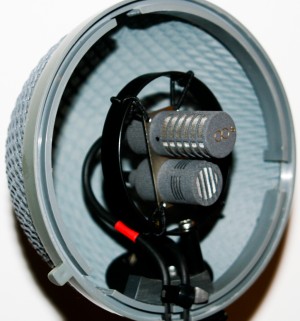
For some background, the Mid-Side (or M/S) recording technique is a coincident miking technique developed by Alan Blumlein, which captures sound from a fixed point in space using two microphones. It provides a natural stereo image that can be easily adjusted or modified after the recording process. There are several plug-ins that allow you to modify the reproduction of sound in space; amongst them the Waves plug-in S1 (stereo imager) and M/S decoder (MS Matrix), which are commonly used by many studios and professionals. Based on similar matrixing  theories are ambisonic recording techniques, which were popularized by the Soundfield microphones and more recently the Double M/S, proposed by Schoeps, arise from the same mathematical theories about the sphere.

One of the most recognized assets of the M/S technique is its versatility and ease of capture. It can be used as a mono cardioid microphone (M) pointed towards the source. During shooting, it can serve as a primary or secondary boom, and for wild recordings it is suitable for recording sound effects, voices, or even music given the circumstances. For ambience recordings it can give a natural stereo image. Due to the extreme proximity between the two microphones, phase problems are avoided, such as those commonly caused by differences in space and angles between the microphones. One down side of this technique is a less defined stereo separation when compared to other stereophonic recording techniques that have greater spacing between microphones, such as AB or ORTF.

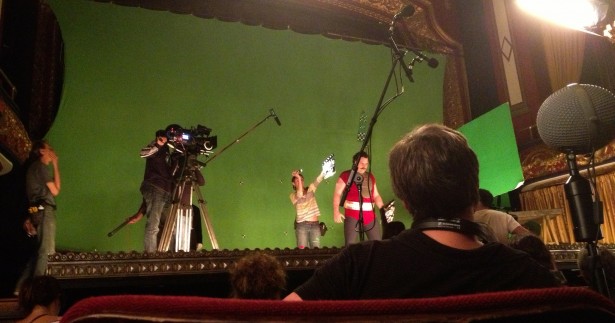
Adding a close M/S pair during a shoot can be used to add detail to busy scenes, or if recorded from a distance, can enhance the atmosphere surrounding the action. These ambience tracks can later be used as a part of your sound library for the project. I benefited from this recently, which I describe in my article about the film War Witch.

During sound editing, we can also dig into the source recordings from alternate takes to boost and enlarge ambiences or crowd atmospheres.

There is often confusion about what to do with the M/S recordings during the editing stage. To clear this up, they should be separated into two categories: dialogue and sound effects. This choice should reflect their expected functions in the final mix. If using your M/S pair as secondary on-location dialogue boom the tracks should be grouped and sorted with the primary dialogue recordings, whereas if your M/S pair is capturing atmospheres (without voices) the tracks should be handled by the sound effects editor, and later treated as a sound effect by the mixer. If used as a sound effect, the M/S tracks will more likely be processed and mixed in stereo, or even surround. Though be sure not to duplicate the sounds into both categories, because if synced by both the dialogue editor and the sound effects editor, phase problems will occur from having duplicate tracks.


Read more →

EvernoteLinkedInGoogle ReaderEmailFacebookGoogle BuzzTwitterGoogle BookmarksTumblrShare

Invited by NexT International Film Festival in Bucarest as a sound designer

Wednesday, May 9th, 2012

Life is full of surprises:

BUCAREST

A short film by Serge Marcotte, The Greens, for which I did sound design, was selected by a film festival in Romania (Bucarest, March 2012). This festival differs from others in that it welcomes both filmmakers and sound designers. On the thirty films in competition, about half were represented by the director or the sound designer, or both. Screenings, meetings, seminars with themes, group meals were on the menu!   Cultural exchange guaranteed!

How come this invitation for sound designers?

As a tribute to a pair of young Romanian director-sound designer, who tragically perished together in a car accident, the “Next Cultural Society” created the Next International Film Festival.  The creative approach of Andre Toncu, the sound designer of the Romanian duo, now serves as an inspiration for all generations of filmmakers and sound designers, a wish that he had made during his lifetime.  What a powerful example of the importance of sound in the film process. I would love not to have to convince anyone of that.

Read more →

EvernoteLinkedInGoogle ReaderEmailFacebookGoogle BuzzTwitterGoogle BookmarksTumblrShare

Web Echoes 2: Sound Design, technical challenge, … innovation

Tuesday, March 20th, 2012

It is still very hard for me to conciliate sound design and web design at the same time. I finished to work on War Witch at the beginning of February, so I am writing a series of posts that will lead to new collections. Stay tuned! A lot of new ahead!

As an appetizer, here are my Web Echoes…

Steve Papagiannis, a supervising sound editor from the Los Angeles area, started Stavrosound blog about six months ago. So far, his articles are oriented towards dialog editing and it’s particularities like crackles or even more dreaming ideas like this.  Very cool!

One Stop Digital, Excellent technical resource for Pro Tools users, published this post that talks about programs that conform sound to picture.  More possibilities.

Another blog about Sound Design is azimutaudio.  He takes the time to review few SFX libraries.

This post from irrationalgames.com has an super article about gun recording.

Read more →

EvernoteLinkedInGoogle ReaderEmailFacebookGoogle BuzzTwitterGoogle BookmarksTumblrShare

Web Echoes 1: Impulse Response, Pro Tools functions and workflow

Wednesday, November 9th, 2011

Internet plays an important role in my creative, technical and learning process. It is also a great source of motivation, particularly when I discovered Sound Designer’s blogs and Independent SFX Libraries and their makers, few years ago. Since then, I improved my surfing skills by using RSS feeds to centralize information in an aggregator daily. Collecting, marking, saving and later following the flow of specialized news that come automatically in my computer without loosing any time searching. Every week, I discover new sites, blogs, SFX boutiques, opinions products, tutorials on a wide range of subjects… The content is accessible and contribute to my reflections and learning about sound. I would like to share a few of particular interest in this Web Echoes 1, an ongoing News Report that I instigate today, as a way to share content and help to grow collectively and individually! This one is more technically oriented towards Impulse Response, Pro Tools functions and workflow, conforming and sound metadata!

1. Brought by Designing Sounds last week, from the team at ArenaNet, they did a recording session in a never completed Nuclear Power Plant, recording tones and all sorts of incredible sounds. Wow! I am very impressed! This presentation video is instructive for our ears as an authentic document for future constructions. I look forward to see more. Impulse Response in progress…

2- This post from Ian Palmer’s Post-Production Sound Blog talks about working from home. It confirms a reality that will increase over time. Technology gives us solutions to work remotely and gain flexibility and efficiency. Ian is starting SFX collections as well, here is the link.

Read more →

EvernoteLinkedInGoogle ReaderEmailFacebookGoogle BuzzTwitterGoogle BookmarksTumblrShare