Given that M/S stereophonic recording theories and practices have existed for over fifty years, many people are still reluctant about its regular use during production or post production, especially during the sound editing and mixing stages. Recent improvements in post-production softwares, along with an increase in computing DSP power, facilitate the integration of this type of recording technique throughout the entire work process.
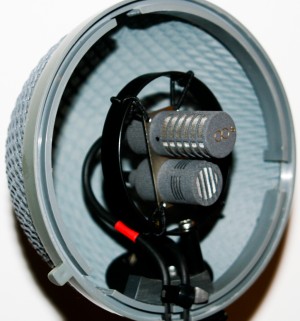
For some background, the Mid-Side (or M/S) recording technique is a coincident miking technique developed by Alan Blumlein, which captures sound from a fixed point in space using two microphones. It provides a natural stereo image that can be easily adjusted or modified after the recording process. There are several plug-ins that allow you to modify the reproduction of sound in space; amongst them the Waves plug-in S1 (stereo imager) and M/S decoder (MS Matrix), which are commonly used by many studios and professionals. Based on similar matrixing theories are ambisonic recording techniques, which were popularized by the Soundfield microphones and more recently the Double M/S, proposed by Schoeps, arise from the same mathematical theories about the sphere.
One of the most recognized assets of the M/S technique is its versatility and ease of capture. It can be used as a mono cardioid microphone (M) pointed towards the source. During shooting, it can serve as a primary or secondary boom, and for wild recordings it is suitable for recording sound effects, voices, or even music given the circumstances. For ambience recordings it can give a natural stereo image. Due to the extreme proximity between the two microphones, phase problems are avoided, such as those commonly caused by differences in space and angles between the microphones. One down side of this technique is a less defined stereo separation when compared to other stereophonic recording techniques that have greater spacing between microphones, such as AB or ORTF.
Adding a close M/S pair during a shoot can be used to add detail to busy scenes, or if recorded from a distance, can enhance the atmosphere surrounding the action. These ambience tracks can later be used as a part of your sound library for the project. I benefited from this recently, which I describe in my article about the film War Witch.
During sound editing, we can also dig into the source recordings from alternate takes to boost and enlarge ambiences or crowd atmospheres.
There is often confusion about what to do with the M/S recordings during the editing stage. To clear this up, they should be separated into two categories: dialogue and sound effects. This choice should reflect their expected functions in the final mix. If using your M/S pair as secondary on-location dialogue boom the tracks should be grouped and sorted with the primary dialogue recordings, whereas if your M/S pair is capturing atmospheres (without voices) the tracks should be handled by the sound effects editor, and later treated as a sound effect by the mixer. If used as a sound effect, the M/S tracks will more likely be processed and mixed in stereo, or even surround. Though be sure not to duplicate the sounds into both categories, because if synced by both the dialogue editor and the sound effects editor, phase problems will occur from having duplicate tracks.


Café de Flore is still warm out of the oven, it reaches this week our screens after exciting Premieres in Venice, Toronto, Montreal, Sherbrooke, Québec, Ste-Adèle and others!